Ashraf Siddiqui
Doha
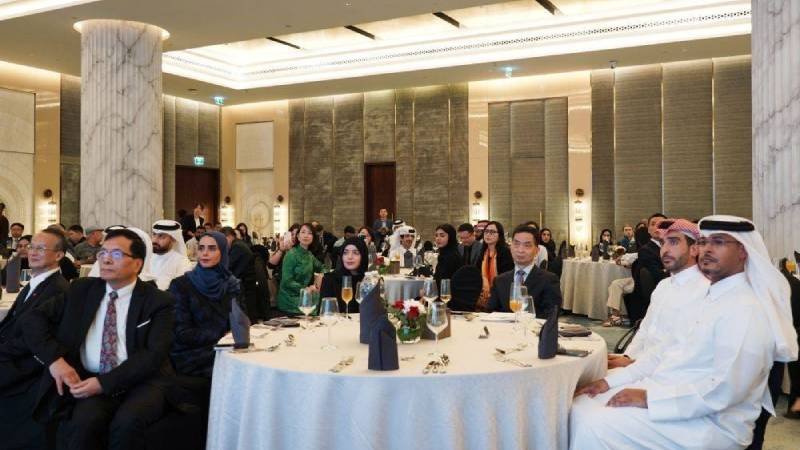
The Chinese Embassy hosted China-Qatar Youth-Exchange and Dialogue meet under the theme 'Let’s Write a New Chapter for the Future of China and Qatar Together’.
Present on the occasion were officials from the Qatari government, media representatives, researchers from think tanks, Chinese language enthusiasts, employees from Chinese companies, teachers, and Chinese students residing in Qatar
Addressing the youth and audience, Ambassador of China to Qatar HE Cao Xiaolin noted that the youth represent a vibrant generation standing at the forefront of China–Qatar cooperation in culture, trade, technology, and beyond.
Gathered to exchange ideas, explore cooperation, and share aspirations, they embody a vital force driving the economic and social development of both countries and serve as a fresh bridge strengthening friendship between the Chinese and Qatari peoples.
Reflecting on the speeches delivered by representatives from the Qatar Leadership Centre, Chinese enterprises, Chinese language learners, and Chinese students living in Qatar, Ambassador Xiaolin observed that when young Chinese converse fluently in Arabic with Qatari peers, and when young Qataris discuss the Chinese language, history, and China’s modern development, they are doing far more than learning languages.
“They are engaging in sincere, people-to-people dialogue rooted in mutual respect and curiosity. It is precisely this spirit that the Chinese Embassy hopes to foster through the dialogue meeting, building bridges of understanding between the youth of both nations, promoting mutual learning between civilisations, and advancing cooperation across diverse fields,” he said.
He recalled that exchanges between Eastern and Middle Eastern civilisations date back thousands of years along the land and maritime Silk Roads. Chinese silk, porcelain, papermaking, and printing reached the Arab world, while Arab achievements in science, mathematics, medicine, astronomy, and philosophy enriched China.
“Cultural relics displayed at the National Museum of Qatar bear witness to this long history of friendly interaction. Although Chinese and Arab civilisations developed as distinct systems, both share enduring values shaped by human progress,” he added.
The envoy added that Chinese philosophy emphasises peace, harmony, and the belief that “all under heaven are brothers,” while Islam teaches goodness, restraint from wrongdoing, and tolerance rooted in humanity’s shared origin.
These shared values, according to him, form the spiritual foundation of China-Arab friendship and offer wisdom for coexistence in an era when globalisation faces challenges and dialogue among civilisations is increasingly vital.
He emphasised that peace, cooperation, openness, inclusiveness, mutual learning, and win-win outcomes have long guided relations between China and Arab states, including Qatar.
He added, “Under the strategic leadership of President Xi Jinping and the Amir His Highness Sheikh Tamim bin Hamad Al Thani, the China-Qatar strategic partnership has experienced over a decade of steady growth. Bilateral relations are now at their strongest level in history, characterised by deepening political trust, strong economic ties, and expanding cultural exchanges.
“China has remained Qatar’s largest trading partner since 2020, while Chinese products and culture continue to gain popularity among Qatari society. People-to-people exchanges are also flourishing, with growing numbers of Qatari youth learning Chinese and rising Chinese tourism to Qatar.
The envoy said that as members of the Global South, China and Qatar share aligned perspectives on many international issues, opposing hegemony and supporting a fairer multipolar world.
Their partnership, he concluded, now extends beyond bilateral cooperation to become an important part of the global landscape of the new era, especially meaningful at a time when peace, development, and trust remain under strain worldwide.